We will share the events with 1 million dentists on our main Facebook page!
Join us and upload nowTooth Preparations – Back to the basics
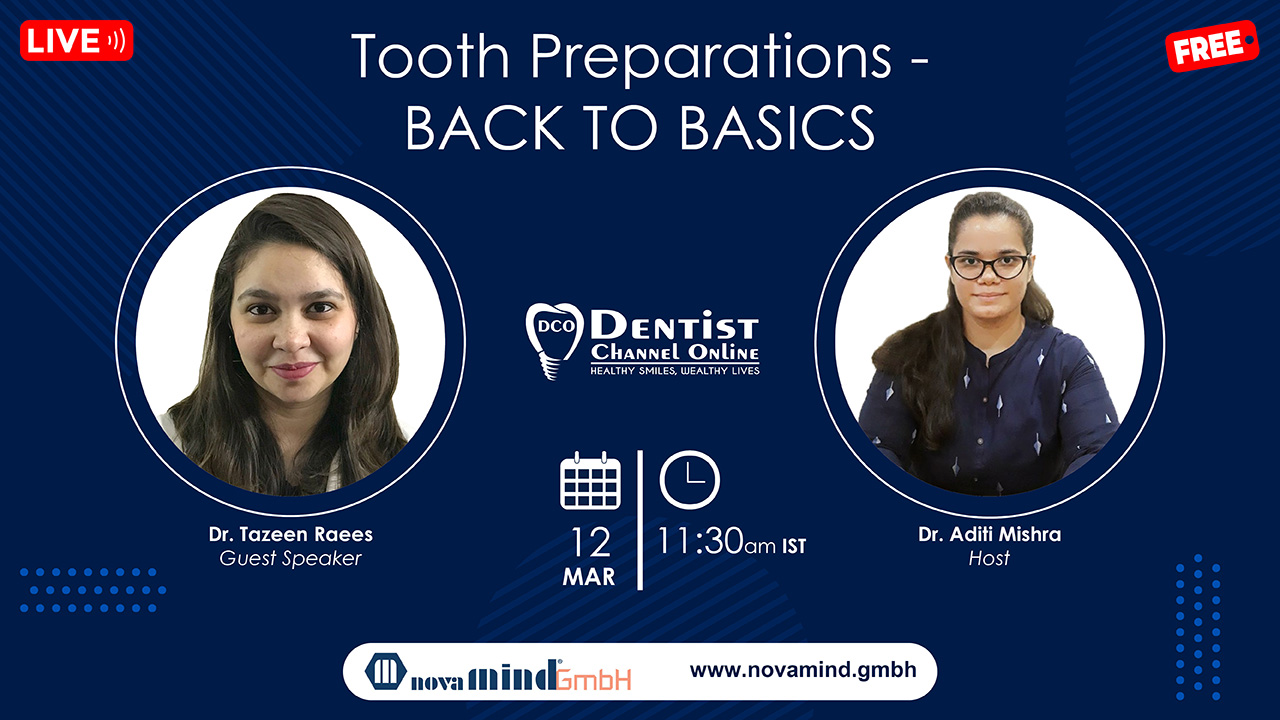
OBJECTIVE :
This webinar aims to provide dental practitioners and students an in-depth understanding about the fundamentals of tooth preparation and various tips and tricks for successful crown and bridge restorations.
Tooth preparation for fixed prosthesis is a common procedure in clinical practice, which all general dentists should perform correctly. However, it could be difficult to obtain always a predictable result, especially for dental students or young doctors: they could make mistakes in their learning curve leading to inadequate results.
Unlike other human substance, dental tissues don’t have regenerative capacity. Therefore, the removal of dental biological material should be planned and executed with maximum attention.
The purpose of a fixed prosthodontic therapy may vary from the restoration of a single tooth to the rehabilitation of the complete occlusion. A single tooth can be fully restored both functionally and aesthetically. A missing tooth can be replaced by a fixed prosthesis, increasing patient masticatory competence and maintaining or improving dental arches function, often elevating patient’s self-image.
Tooth preparation should have specific geometrical characteristics to provide necessary retention and resistance to the vertical and lateral forces acting on the restoration. The most important element of retention is the presence of two opposing vertical surfaces. The axial walls of the preparation should taper slightly to allow the cementation of the artificial crown. The more parallel are the axial walls the greater is the retention. However, it is impossible to obtain parallel surfaces without producing undercuts. Goodacre et al.suggest an angle of convergence between 10 and 20°. Moreover, the occlusocervical length is another fundamental factor for both retention and resistance. The longer is the preparation the greater is the retention. Teeth with larger diameter need a greater length to prevent dislodgement. Proper occlusal and axial reductions are essentials to provide enough space, allowing a good functional morphology and structural durability. Moreover, no more than necessary dental tissues should be removed in order not to jeopardize tooth structure and retention of the restoration.
WHAT WILL YOU LEARN IN THIS SESSION ?
- Introduction
- Important factors influencing the success of crown and bridge restorations
- Tooth Preparation Checklist for Predictable Outcomes
- Burs used for tooth preparations
- Steps involved in Tooth Preparation
- Demonstration – Tooth Preparation
- Conclusion
- Live Q & A
DATE : Saturday, March 12, 2022
TIME : 11.30 AM IST

Leave a comment